Why Business Training Alone Doesn't Close the Gender Gap in Entrepreneurship

A study of 20,000 entrepreneurs reveals why training is not a silver bullet, and how family business experience helps women get more from support programs.
Women often face barriers to financial capital, influential networks, legitimacy, and other resources when starting and growing businesses. They may also encounter gender stereotypes that influence how investors, suppliers, employees, and other stakeholders evaluate their businesses.
Governments, universities, accelerators, financial institutions, and other organizations have responded by investing heavily in entrepreneurship support programs to offer workshops, training, mentoring, networking, and funding opportunities to build stronger businesses. Yet offering the same business support to everyone does not necessarily close the performance gap between male- and female-led ventures.
Our study of more than 20,000 U.S. entrepreneurs shows that business support alone does not close the gender performance gap. Its benefits depend partly on what entrepreneurs bring with them.
Why Support Can Benefit Entrepreneurs Differently
Formal business support is designed, in part, to help entrepreneurs build the capabilities to run and grow ventures. Accelerators and similar programs can connect founders with mentors, experts, and potential resource providers. However, entrepreneurs enter training and mentoring with different starting points. They have very different experiences, skills, networks, and knowledge. Importantly, some have spent years around a family business, developing the intent to become entrepreneurs and an understanding of the importance of carrying on a family business in the future, which we call entrepreneurial legacy. Those growing up around family businesses observe family members’ actions, hear stories about the business, participate in business activities, and learn informally about decision-making, customer and employee relations, business finances, and risk. Others without a family business background encounter these ideas for the first time through a support program.
Having a family business background can be particularly important for female entrepreneurs because entrepreneurship has long been associated with masculine traits such as assertiveness, risk-taking, and independence. Female entrepreneurs in entrepreneurial environments may lack the same perceived fit or legitimacy afforded to their male counterparts. A family business background can provide a different starting point. Female entrepreneurs exposed to entrepreneurship early in life may develop greater familiarity with business practices, stronger entrepreneurial identities, and cognitive frameworks for understanding opportunities, risks, and resource decisions. We therefore expect that female entrepreneurs with a stronger entrepreneurial legacy will help narrow the performance gap between male- and female-led ventures.
More importantly, we expected entrepreneurial legacy and formal business support to work together. Someone already familiar with entrepreneurial concepts and environments may be better positioned to recognize why specific advice matters, ask useful questions, connect new information to prior knowledge, and apply what a support program offers. In this sense, entrepreneurial legacy can provide a foundation for formal business support to build on, further narrowing the performance gap between male- and female-led ventures.
What We Studied
We examined 20,369 entrepreneurs in the United States using Entrepreneurship in the Population survey (EPOP) data from 2022 through 2024. The survey is administered by NORC at the University of Chicago with funding from the Ewing Marion Kauffman Foundation. We focused on current business owners and freelancers and excluded nonprofit ventures.
We measured venture performance using annual revenue. We then examined three important factors. First, we compared female and male entrepreneurs. Second, we measured formal business support based on whether entrepreneurs had attended business-related training, workshops, or webinars offered by business support organizations. Third, entrepreneurial legacy was measured using an ordinal variable that reflected how important “carrying on the family business” was as a reason for pursuing entrepreneurship: 1 = not important, 2 = somewhat important, and 3 = very important. This measure captures the stated importance of family business role models and environments’ lasting influence on participants’ entrepreneurial behaviors and performance outcomes.
Our analyses also accounted for other factors that could affect venture performance, including education, previous entrepreneurial experience, household income, age, citizenship, race, internal and external networks, firm age, industry, geographic region, and survey year.
What We Found
Our first finding confirmed the underlying performance gap. After accounting for other factors in our analyses, female entrepreneurs earned about $16,000 less in annual venture revenue than comparable male entrepreneurs. We found no statistically significant evidence that formal business support alone narrowed the performance gap. This suggests that formal business support alone did not resolve the performance disadvantage faced by female entrepreneurs.
Including entrepreneurial legacy in the analysis changed the picture. The more carrying on the family business mattered to female entrepreneurs, the smaller the performance difference between male and female entrepreneurs became. For example, a one-step change in response from “not important” to “somewhat important” narrowed the female-male performance gap by about $4,854, with female entrepreneurs performing closer to their male counterparts when evaluated at the same level of entrepreneurial legacy. Most importantly, we found that the benefit of business support for female entrepreneurs depended partly on entrepreneurial legacy. Female entrepreneurs who reported that continuing a family business was important had higher business revenue when they attended business support programs than when they did not, or when continuing the family business was not important.
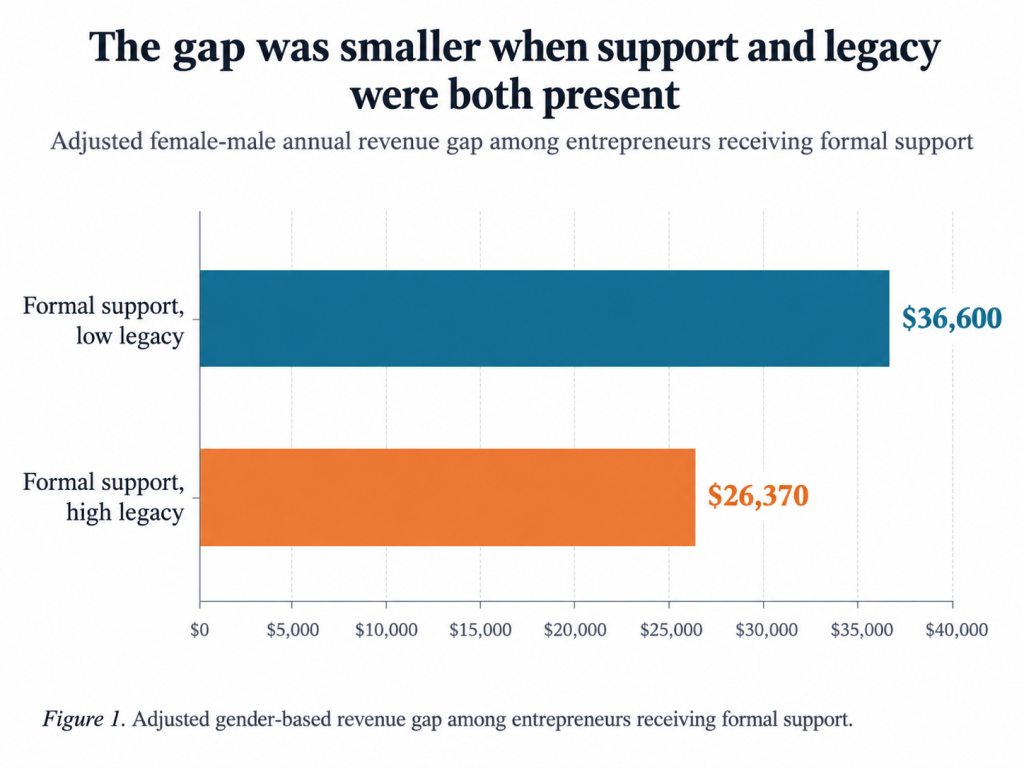
Model-based comparisons make this pattern clear in our results. Among entrepreneurs receiving formal business support, the estimated female-male performance gap was about $36,600 in the low entrepreneurial legacy comparison and about $26,370 when legacy was high. These adjusted comparisons suggest that formal support and entrepreneurial legacy can operate as complementary resources, with support alone potentially leaving some female entrepreneurs without the foundation needed to use it fully. Business support provides additional knowledge and resources, while entrepreneurial legacy may help female entrepreneurs recognize, absorb, and apply them.
We found similar joint patterns among younger ventures and in male-dominated industries, such as construction, manufacturing, and information technology. However, we did not observe the same significant combined effect of formal support and entrepreneurial legacy in reducing the female-male performance gap in female-dominated industries. Together, these results suggest that asking whether entrepreneurship support programs “work” may be the wrong question.
A better question is: For whom do they work, and under what conditions?
Takeaways for Female Entrepreneurs
The main lesson is not that entrepreneurship programs are ineffective. Training, accelerators, workshops, and other support organizations can provide valuable information, resources, and connections. Instead, entrepreneurs should recognize that participating in a program does not automatically improve business performance. What matters is whether they can turn the resources the program provides into action within their businesses.
Entrepreneurs who grew up around family businesses may already have some of the background knowledge needed to act effectively on business support. They may understand basic business terminology, feel more comfortable interacting with business professionals, or have observed family members handle customers, employees, suppliers, and financial decisions.
The findings do not mean that female entrepreneurs without family business background are less capable or should avoid support programs. The measure captures one type of entrepreneurial legacy, and the skills and knowledge associated with it can be developed through other channels.
Before or during a support program, entrepreneurs can ask themselves what foundational knowledge would help them act on the advice. For example, they can practice reading basic financial statements, discussing pricing strategies, describing their customers, or preparing a financing request. This approach helps them discuss what they are learning with a mentor or experienced entrepreneurs and build the confidence to apply that knowledge to their own ventures.
Seek ongoing, practical contact with a mentor and follow-up opportunities after participating in a formal support program. Joining peer entrepreneurial groups, gaining practical business experience through suppliers and customers, and connecting with similar businesses may help entrepreneurs acquire some of the knowledge others gain informally through family businesses. The objective should not simply be to attend more programs, but to develop the capacity to translate what those programs provide into usable business knowledge over time.
Takeaways for Entrepreneurship Support Organizations and Policymakers
Our findings may be even more relevant to accelerators, incubators, universities, government agencies, and other organizations that design entrepreneurship support programs. Support organizations should assess participants' prior entrepreneurial exposure and experience before determining the assistance they need. A workshop on customer acquisition, financial modeling, investment strategy, or scaling may assume that participants already understand the basic terms and practices underlying those topics. Before choosing an intervention, ask participants about their prior exposure, experience, financial knowledge, networks, and immediate business needs. Use this information to tailor support, because gender alone does not capture all the differences in what entrepreneurs need to benefit from support. Programs should therefore pay attention not only to who receives support but also to whether entrepreneurs have the foundational capabilities needed to use it.
Offer more foundational preparation for participants who need it. For example, provide introductory financial and managerial training, repeated interactions with experienced entrepreneurs, longer-term mentoring, and structured follow-up after a program ends. These interventions can help entrepreneurs develop a “synthetic entrepreneurial legacy” by deliberately building familiarity with knowledge, confidence, and ways of thinking about business, rather than inheriting it through years of family business exposure. Therefore, providers could view support programs as a longer process of building knowledge and experience.
Program designers should also reconsider how they identify promising entrepreneurs by recognizing different starting points, without using them as gatekeeping criteria. Selection criteria that emphasize existing networks, prior accomplishments such as filing or acquiring a patent, or growth potential may favor entrepreneurs who already have backgrounds and are familiar with business systems. The challenge is to recognize different starting points and contexts without allowing them to become another barrier to receiving support. Hence, pair standards for program fit with accessible preparation and treat background information as a guide to support needs. These efforts will expand access to support programs and help reduce disparities among entrepreneurs.
Ultimately, entrepreneurship support should not be viewed as a silver bullet. Providing entrepreneurs with access to resources is important, but it is only the first step. Some entrepreneurs enter these programs with years of business experience, while others encounter many of these ideas for the first time. That difference shapes how much they can gain from the same program. Effective support requires understanding what entrepreneurs already know, the industry environment they operate in, and their business stage, and helping them build the capacity to translate external assistance into improved business performance.
Pathways for Future Research
Can entrepreneurship programs create the benefits of an entrepreneurial legacy? We found that women who placed greater importance on carrying on a family business were better able to benefit from formal support. Future research can examine whether mentoring, foundational training, and sustained contact with experienced entrepreneurs can build similar familiarity—and which approaches work best across venture stages and industries.
Explore the Research
Beyond the silver bullet: How entrepreneurial legacy catalyses formal business support benefits for female entrepreneurs. International Small Business Journal, May 2026.

Assistant Professor of Entrepreneurship / Marketing, Entrepreneurship, Hospitality and Tourism / University of North Carolina at Greensboro
View Profile


Assistant Professor of Entrepreneurship / School of Innovation and Entrepreneurship / Rowan University
View Profile