Why Family Businesses Shouldn't Always Listen to Wall Street

What Nordstrom, Mars, Dillards and Patagonia can teach family businesses about ownership structure.
In May 2025, Nordstrom ended more than five decades as a publicly traded company. Members of the Nordstrom family and Mexican retailer El Puerto de Liverpool completed a deal worth approximately $6.25 billion, leaving the family with 50.1% of the company and Liverpool with 49.9%. Nordstrom returned to private ownership, with the founding family holding the majority stake (Nordstrom, Inc., 2024, 2025).
The decision came after Nordstrom had gone through a period of declining fortunes – brought on by an unsuccessful expansion into Canada, the shift to e-commerce, the pandemic, and other problems. It reversed a path that began with its public offering in 1971, when Nordstrom had grown beyond its roots as a Seattle shoe retailer, expanded into apparel, and entered a period of rapid geographic growth. Going public gave the company access to outside capital and a liquid market for its shares while family members retained substantial ownership. The downside was that Nordstrom’s leaders had to balance the family’s priorities with the expectations of public shareholders (Nordstrom, Inc., n.d.).
Returning to private ownership half a century later has improved the company’s fortunes. It returned control of the timetable to the Nordstrom family. Rather than continually demonstrating progress to dispersed public shareholders, analysts, and the stock market, the Nordstrom family and Liverpool would have greater influence over the pace and priorities of the turnaround.
Early results are encouraging. Fortune reported fiscal 2025 revenue of $15.9 billion, stronger operating profit, and renewed investment in stores, inventory systems, personalization, and customer service (Wahba, 2026a, 2026b). Co-CEO Erik Nordstrom described the company as “playing from a position of strength” (Moin, 2026). However, the deeper significance of the new ownership structure is not a single year’s performance. It is now that the Nordstrom family and Liverpool will determine how the turnaround will be evaluated and how much time its investments will receive.
Nordstrom’s decision raises a question for family businesses of every size: Does our ownership structure give the business the time its strategy requires, or do expectations for faster profits, payouts, and visible results keep pulling it toward a shorter horizon?
Wall Street’s Shorter Timetable
Public markets offer important advantages, including access to capital, liquidity for shareholders, visibility, and external discipline. But Wall Street also rewards frequent, measurable results. Quarterly earnings, analyst forecasts, share-price movements, dividends, and stock buybacks keep attention focused on what the company can deliver soon. Corporate short-termism arises when pressure to deliver immediate results causes managers to defer or abandon investments, such as innovation, capability building, and employee development, that could strengthen the company’s long-term competitiveness (Wiersema et al., 2025).
The problem is that rebuilding a brand, entering a new market; developing future leaders; transforming digital systems; training employees; or preserving important customer, supplier, and community relationships all take time. They require resources today, while their full value may take years to emerge. Family firms are inherently comfortable with this longer horizon, which can be a source of strength for them. In fact, research on family firms shows that sustained investments in people, knowledge, partnerships, and strategic renewal can build capabilities that competitors find difficult to copy and can help firms endure periods of adversity (Le Breton-Miller & Miller, 2006; Yilmaz et al., 2024).
Why a Longer Horizon Matters
Family owners often evaluate the business based on more than just current financial returns. The concept of socioemotional wealth captures the identity, influence, reputation, relationships, and sense of continuity that families derive from owning a company (Gómez-Mejía et al., 2007; Berrone et al., 2012). Because these benefits extend beyond a single quarter and often beyond a single generation, family owners may be more willing to accept delayed financial returns to protect the company, its employees, its reputation, and the legacy they hope to pass on. This capacity to keep capital committed while waiting for a longer-term payoff is often described as patient capital.
A long-term orientation can help family firms turn that patience into resilience and renewal. A systematic review of 87 studies identified long-term orientation and family values as central drivers of family business resilience because they support patient capital, committed employees, enduring relationships, and the capacity for strategic renewal (Yilmaz et al., 2024). McKinsey’s 2023 study of large family businesses found a similar pattern: leaders of the highest-performing firms identified a long-term perspective as one of the three leading reasons for their success, alongside innovation and expansion into new markets.
This can have a downside. Being so committed to continuity can mean that families delay necessary change. However, the picture changes when long-term orientation is connected to thoughtful strategic choices. Research shows that long-term orientation contributes to corporate entrepreneurship when family firms also use comprehensive strategic decision-making (Eddleston et al., 2012). In practical terms, ownership creates value when it gives a clear strategy enough time to work.
Four Ownership Strategies for Protecting a Longer Horizon
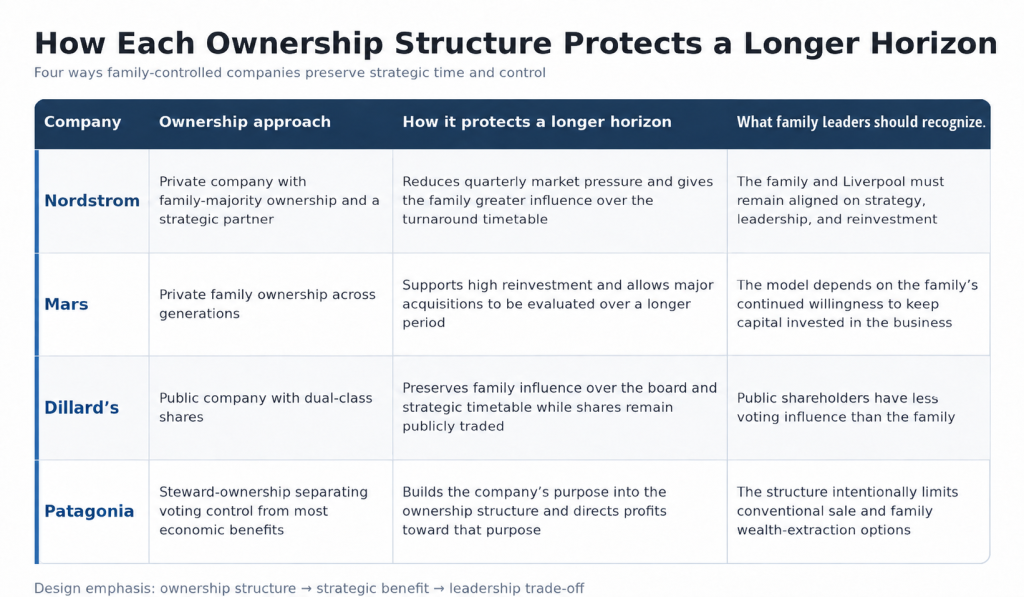
Along with Nordstrom, three other firms -- Mars, Dillard’s, and Patagonia -- demonstrate that family firms can protect long-term priorities through very different ownership arrangements. The structures differ, but each reflects an intentional effort to prevent important long-term priorities from being repeatedly displaced by demands for faster financial returns.
Nordstrom: Return to Private, Family-Majority Ownership
The May 2025 arrangement with Liverpool did not restore the Nordstrom family’s full ownership. Instead, it combined family majority ownership with a strategic partner that brings substantial retail experience and capital. The structure gives the Nordstrom family greater influence over the pace and priorities of the turnaround while preserving the benefits of an outside partner. It also makes alignment between the family and Liverpool especially important: Both must agree on strategy, leadership, reinvestment, and how much time the turnaround should receive.
For Pete Nordstrom, the decision carries a generational weight that is difficult to separate from the company’s strategy. “We don’t want to be known as the generation of Nordstroms that screwed it up,” he told Fortune (Wahba, 2026b). The remark reveals a broader definition of success. The fourth generation is concerned not only with improving current performance, but also with the condition of the company it will leave to the fifth. That perspective may strengthen the family’s willingness to support a difficult turnaround and rebuild customer experience, systems, and capabilities whose payoff will take time. It does not make the family infallible, but it gives the turnaround a longer horizon on which to succeed.
Mars: Stay Private and Reinvest
Mars chose a different path: it never surrendered family ownership. More than a century after its founding, the company remains privately held across five generations. Mars reports that it reinvests more than 90% of its profits in the business, supporting brands, facilities, capabilities, and acquisitions (Mars, Incorporated, n.d.). Its ownership structure allows the family to keep substantial capital inside the company and evaluate major investments over a period that may extend well beyond a public-market reporting cycle.
That capacity was visible in December 2025, when Mars completed its $35.9 billion acquisition of Kellanova, adding brands such as Pringles and Cheez-It to its portfolio (Mars, Incorporated, 2024; 2025). Integrating an acquisition of that size, strengthening its brands, and realizing its strategic value will take years. Private family ownership gives Mars greater discretion over that timetable and allows the family to judge the acquisition as part of a much longer effort to build the company’s portfolio and global reach.
Dillard’s: Use Public Capital While Retaining Family Influence
Dillard’s shows that a family can remain in public markets while preserving substantial influence over strategic direction. Its dual-class share structure allows holders of Class B shares to elect two-thirds of the board, while Class A shareholders elect the remaining third (Dillard’s, Inc., 2026). The company, therefore, retains the liquidity and visibility associated with public ownership while the founding family maintains greater influence over board composition than it would under a one-share, one-vote structure.
That voting control helps explain why retail professor Mark Cohen described Dillard’s as being “run in many ways as if it were private” (Howland, 2019). Public shareholders participate in the company’s financial performance, but the family has a greater ability to sustain a strategy that may not match the market’s preferred timetable. Dillard’s, therefore, represents a middle path: the company remains publicly traded, yet its ownership structure gives the family a stronger voice over how quickly strategic choices are judged.
Patagonia: Place Purpose Beyond the Family’s Economic Claims
Patagonia adopted the most unconventional approach. In 2022, the Chouinard family transferred all voting stock—about 2% of the company’s shares—to the Patagonia Purpose Trust. The remaining nonvoting stock went to the Holdfast Collective, a nonprofit that receives profits not reinvested in Patagonia and uses them to address the environmental crisis (Chouinard, 2022).
This arrangement is an example of steward-ownership, a model that separates control of the company from the right to receive most of its economic benefits. Research identifies two central features: control is placed with people or entities responsible for protecting the company’s purpose, and an asset lock limits the ability to extract company value for private gain (Manelli et al., 2026). At Patagonia, the trust protects the company’s values and voting control, while the nonprofit receives the economic benefit.
Yvon Chouinard was explicit about the time horizon he wanted to preserve. He argued that even public companies with good intentions face too much pressure to create short-term gain “at the expense of long-term vitality and responsibility.” Patagonia’s alternative, he wrote, was not “going public” but “going purpose” (Chouinard, 2022). The structure makes a conventional sale, public offering, or redirection of profits for private gain much harder. Chouinard viewed those limits as essential protection for Patagonia’s mission. Other families may want future generations to retain more options, which is why steward-ownership is one possible strategy rather than a universal model.
Does Your Ownership Structure Protect the Time Horizon You Need?
Most family businesses will never go public or take a multibillion-dollar company private. Yet the central issue in these examples appears in family firms of every size. Ownership expectations influence how long a business can wait for an investment to pay off, how much profit can be reinvested, and how readily a strategy can be redirected when results are slow to appear. These pressures may come from the stock market, an outside investor, lenders, or family shareholders whose dividend and liquidity needs have changed. The key is whether the existing ownership structure gives the business sufficient time and authority to pursue its long-term ambitions.
Here are some questions that families should ask themselves:
- What are we trying to build, and how much time will the strategy realistically require before its results become visible?
- What expectations, from family shareholders, outside investors, lenders, or the market, could pressure us to pursue faster profits, payouts, or results?
- As ownership becomes more dispersed across generations, will our agreements and decision processes continue to protect the time horizon the business needs?
The answers may confirm that the current structure strongly supports the family’s ambitions. They may also expose a quieter mismatch: a long-term strategy paired with short-term distribution expectations, shareholders who need liquidity, or family branches that no longer agree on how long the business should wait. Recognizing a mismatch early gives the family more choices and prepares them for adversity before it strikes. It can clarify dividend policies, shareholder liquidity arrangements, voting rights, and expectations about reinvestment before financial pressure becomes a strategic crisis.
Looking Far Ahead
Nordstrom, Mars, Dillard’s, and Patagonia chose different ownership strategies, but each sought to protect a longer-term priority: a turnaround, continued reinvestment, family influence, or an enduring purpose. Every family business should understand what its own structure protects. The question is not simply who owns the company. It is whether those owners will give the business the time it needs to become what the family intends it to be.
References
Asaf, E., Carvalho, I., Leke, A., Malatesta, F., & Tellechea, J. (2023, November 28). The secrets of outperforming family-owned businesses: How they create value—and how you can become one. McKinsey & Company. https://www.mckinsey.com/industries/private-capital/our-insights/the-secrets-of-outperforming-family-owned-businesses-how-they-create-value-and-how-you-can-become-one
Barton, D., Manyika, J., Koller, T., Palter, R., Godsall, J., & Zoffer, J. (2017, February 7). Where companies with a long-term view outperform their peers. McKinsey & Company. https://www.mckinsey.com/featured-insights/long-term-capitalism/where-companies-with-a-long-term-view-outperform-their-peers
Berrone, P., Cruz, C., & Gómez-Mejía, L. R. (2012). Socioemotional wealth in family firms: Theoretical dimensions, assessment approaches, and agenda for future research. Family Business Review, 25(3), 258–279. https://doi.org/10.1177/0894486511435355
Chouinard, Y. (2022, September 14). Earth is now our only shareholder. Patagonia. https://www.patagonia.com/ownership/
Chua, J. H., Chrisman, J. J., Wang, H., & Wu, S. (2025). Misconceptions about the theoretical support for family firm long-term orientation. Entrepreneurship Theory and Practice, 49(2), 359–374. https://doi.org/10.1177/10422587241300432
Diaz-Moriana, V., Clinton, E., Faherty, C., & O’Gorman, C. (2025). Resilience behaviors and temporal orientation in family firms. Family Business Review, 38(3), 184–209. https://doi.org/10.1177/08944865251341696
Dillard’s, Inc. (2026). Annual report for the fiscal year ended January 31, 2026. U.S. Securities and Exchange Commission. https://www.sec.gov/Archives/edgar/data/28917/000002891726000006/dds-20260131x10k.htm
Eddleston, K. A., Kellermanns, F. W., & Zellweger, T. M. (2012). Exploring the entrepreneurial behavior of family firms: Does the stewardship perspective explain differences? Entrepreneurship Theory and Practice, 36(2), 347–367. https://doi.org/10.1111/j.1540-6520.2010.00402.x
Gómez-Mejía, L. R., Haynes, K. T., Núñez-Nickel, M., Jacobson, K. J. L., & Moyano-Fuentes, J. (2007). Socioemotional wealth and business risks in family-controlled firms: Evidence from Spanish olive oil mills. Administrative Science Quarterly, 52(1), 106–137. https://doi.org/10.2189/asqu.52.1.106
Halverson, A. (2024, September 4). What’s behind Nordstrom family’s $3.8B play to take control of company. The Seattle Times. https://www.seattletimes.com/business/nordstrom-family-offers-3-8-billion-to-take-seattle-company-private/
Howland, D. (2019, September 9). The downside of tradition at Dillard’s. Retail Dive. https://www.retaildive.com/news/the-downside-of-tradition-at-dillards/562320/
Koller, T., Manyika, J., & Ramaswamy, S. (2017, August 4). The case against corporate short termism. McKinsey & Company. https://www.mckinsey.com/mgi/media-center/the-case-against-corporate-short-termism
Le Breton-Miller, I., & Miller, D. (2006). Why do some family businesses out-compete? Governance, long-term orientations, and sustainable capability. Entrepreneurship Theory and Practice, 30(6), 731–746. https://doi.org/10.1111/j.1540-6520.2006.00147.x
Lumpkin, G. T., & Brigham, K. H. (2011). Long-term orientation and intertemporal choice in family firms. Entrepreneurship Theory and Practice, 35(6), 1149–1169. https://doi.org/10.1111/j.1540-6520.2011.00495.x
Manelli, L., Pek, S., Waldkirch, M., Hachigian, H., Jamal, A., Thomsen, S., Besharov, M., Hand, M., Segrestin, B., Levillain, K., & Hatchuel, A. (2026). Beyond ownership as usual: The implications of steward-ownership for management research. Journal of Management Inquiry, 35(3), 227–252. https://doi.org/10.1177/10564926251357812
Mars, Incorporated. (n.d.). The Mars Compass provides direction and transparency. https://www.mars.com/about/mars-compass
Mars, Incorporated. (2024, August 14). Mars to acquire Kellanova.
Mars, Incorporated. (2025, December 11). Mars completes acquisition of Kellanova. https://www.mars.com/news-and-stories/press-releases-statements/mars-completes-acquisition-of-kellanova
Moin, D. (2025, November 10). The Nordstroms open up on why they took their company private. WWD. https://wwd.com/business-news/retail/nordstrom-erik-pete-discuss-why-they-took-their-company-private-1238328981/
Moin, D. (2026, February 12). The Nordstroms on going private, Liverpool and what lies ahead. WWD. https://wwd.com/business-news/retail/the-nordstroms-on-going-private-liverpool-and-the-future-1238455073/
Nordstrom, Inc. (n.d.). Company history. https://www.nordstrom.com/browse/about/company-history
Nordstrom, Inc. (2024, December 23). Nordstrom to be acquired by Nordstrom family and Liverpool. U.S. Securities and Exchange Commission. https://www.sec.gov/Archives/edgar/data/72333/000121390024111521/ea022568701ex99-1_nord.htm
Nordstrom, Inc. (2025, May 20). Nordstrom announces completion of acquisition by Nordstrom family and Liverpool. https://press.nordstrom.com/news-releases/news-release-details/nordstrom-announces-completion-acquisition-nordstrom-family-and
Romano, B. (2018, March 9). Despite rebuff, Nordstrom buyout effort is not over. The Seattle Times. https://www.seattletimes.com/business/despite-rebuff-nordstrom-buyout-effort-is-not-over/
Sampson, R. C., & Shi, Y. (2023). Are U.S. firms becoming more short-term oriented? Evidence of shifting firm time horizons from implied discount rates, 1980–2013. Strategic Management Journal, 44(1), 231–263. https://doi.org/10.1002/smj.3158
Wahba, P. (2026a, March 16). Nordstrom’s “glow-up”: How going private is helping the retailer thrive as Saks Global languishes. Fortune. https://fortune.com/2026/03/16/nordstrom-wall-street-department-stores-turnaround/
Wahba, P. (2026b, March 31). Nordstrom’s $6.25 billion deal to go private is paying off—and don’t expect an IPO anytime soon. Fortune. https://fortune.com/2026/03/31/nordstrom-private-liverpool-ipo-wall-street/
Wiersema, M., Koo, H., Chen, W., & Zhang, Y. (2025). Corporate short-termism: A review and research agenda. Journal of Management, 51(6), 2389–2418. https://doi.org/10.1177/01492063241303392
Yilmaz, Y., Raetze, S., de Groote, J., & Kammerlander, N. (2024). Resilience in family businesses: A systematic literature review. Family Business Review, 37(1), 60–88. https://doi.org/10.1177/08944865231223372


Schulze Distinguished Professor of Entrepreneurship / D'Amore-McKim School of Business / Northeastern University
View Profile